// Stillaguamish River town · Olympic Avenue main street
Arlington
A river town at the meeting of the Stillaguamish’s two forks, with a preserved Olympic Avenue main street and a 30-mile rail-trail at the edge of downtown.
Arlington sits at the confluence of the North and South Forks of the Stillaguamish River, about 35 miles north of Seattle. Washington’s Office of Financial Management counted about 23,390 residents as of April 1, 2026, up from 19,868 in the 2020 Census. Platted in 1890 and incorporated in 1903, it grew from a farming and logging town into a close-knit community with one of the best-preserved historic main streets in the county. This guide covers Arlington’s neighborhoods, parks, downtown, schools, and the real estate picture for anyone considering a move here. Census QuickFacts
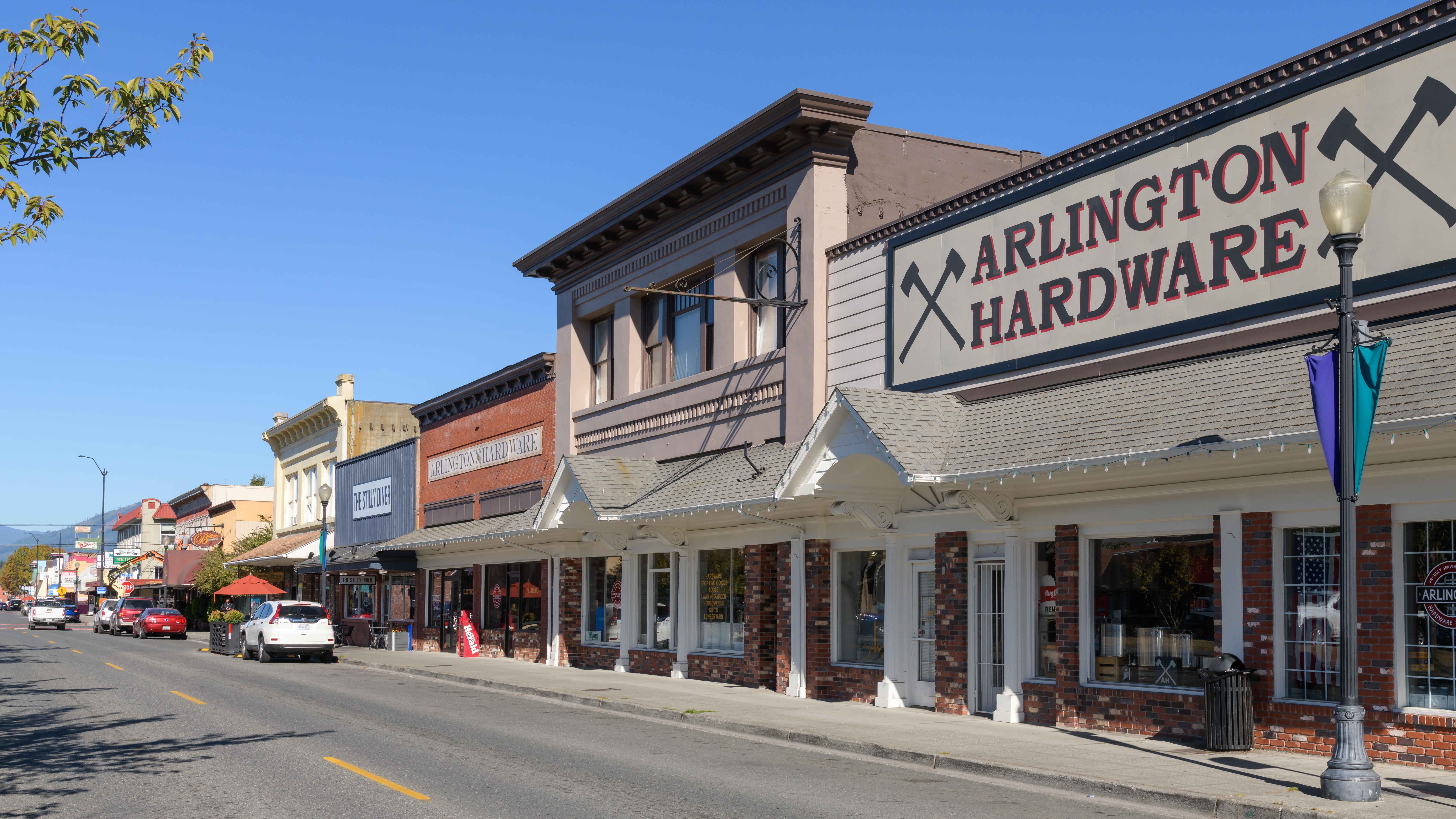
Historic downtown on Olympic Avenue
Arlington Hardware · Arlington, WA
Population
About 23,400 people (2020 Census: 19,868; WA Office of Financial Management April 1, 2026 estimate: 23,390)
Typical commute
About 15 to 20 minutes to Everett; 50 to 65 minutes to Seattle via I-5
Schools
Arlington School District serves the city, with Arlington High, Haller Middle, and Post Middle
Where it sits
ZIP 98223, where the two forks of the Stillaguamish River meet, about 35 miles north of Seattle
// The honest trade-offs
Relocating to Arlington: The Quick View
Arlington is a river town that wears its history well: a preserved Olympic Avenue main street, the Centennial Trail at the edge of downtown, and the Stillaguamish running through it. It delivers a genuine small-town feel and real river recreation, and it asks you to trade freeway convenience and a longer commute in return. Here is the quick view, straight, so you can decide whether it fits.
Why people move here
A preserved Olympic Avenue main street
The six-block 2007 reconstruction of Olympic Avenue, from Maple Street to Division Street, turned the historic commercial street into a true gathering place. Arlington Hardware has anchored the block since 1903, and cafes, restaurants, and the July 4th parade route fill it today.
The Centennial Trail ends right here
The 30-mile paved rail-trail runs from Snohomish north to the Nakashima Heritage Barn at the edge of Arlington, and it connects to the Whitehorse Trail heading east toward Darrington and the Mountain Loop. Trailheads at the barn, Armar Road, and Bryant put the whole system within reach.
Two rivers and real river recreation
The North and South Forks of the Stillaguamish meet just east of downtown. Twin Rivers Park at the confluence offers river trails, wide gravel bars, picnic areas, and a 19-hole disc golf course, with Haller Park as the riverfront park in town.
A town that fills its downtown
The Hometown July 4th Celebration, the Saturday farmers market at Legion Park, free summer concerts, and the Hometown Holidays season keep Olympic Avenue busy year-round.
The honest trade-offs
The commute is a real factor
Arlington sits east of I-5 on State Routes 9 and 530, so Seattle is a solid hour in good traffic, and the corridor through Marysville and Everett backs up at peak hours.
The river has flood history
The Stillaguamish floods, and riverside areas carry that history. Twin Rivers Park was submerged in the record December 2023 flood, so floodplain awareness belongs on the checklist for river-adjacent properties.
Most big-box shopping is a short drive
Downtown Arlington is boutique-scale, so the widest retail, grocery, and dining choices sit at Smokey Point or in Everett and Marysville a short drive away.
Foothills weather runs gray
Arlington gets the marine rain of the Puget Sound region with a foothills dose of it, and the higher routes east see occasional snow in winter.
// The commute, honestly
Commuting from Arlington: the honest picture
Arlington sits east of I-5 on State Routes 9 and 530, so almost every commute starts with a drive to Smokey Point and the freeway. Everett and Boeing are the realistic daily markets; Seattle is a real haul. The ranges below are approximate weekday figures that swing with departure time, weather, and incidents, so treat them as planning numbers, not promises.
| Destination | Main route | Off-peak | Rush hour |
|---|---|---|---|
| Everett | SR 531 to I-5 west, or SR 9 south | About 20 to 25 minutes | About 35 to 45 minutes or more at peak; the stretch through Marysville and Everett is one of the region’s busiest |
| Seattle | SR 9 / SR 531 to I-5 south | About 50 to 65 minutes | About 75 to 95 minutes in the worst of peak |
| Bellevue / Redmond | I-5 to I-405, then SR-520 or NE 8th | About 50 to 60 minutes | About 75 to 90 minutes or more |
| Boeing / Paine Field | I-5 south to SR 526 or Airport Road | About 25 to 35 minutes | About 40 to 50 minutes; add shift-change queues near the plant |
Approximate ranges drawn from WSDOT travel-time data, routing tools, and local commuter reports; winter weather and incidents add time on SR 9 and I-5. WSDOT Arlington-Everett travel time
Community Transit in Arlington
Route 220 links Arlington to the Smokey Point Transit Center, routes 201 and 202 connect Smokey Point to the Lynnwood City Center light rail station, and routes 209 and 230 reach Lake Stevens and Darrington. There is no direct bus to Everett, so riders transfer at Smokey Point.
Arlington transit guideLink light rail at Lynnwood City Center
The Link 1 Line opened at Lynnwood City Center on August 30, 2024, about 25 minutes south on I-5, with downtown Seattle roughly 35 to 40 minutes away by train. The planned Everett Link extension, expected in the late 2030s to early 2040s, will not reach Arlington, so Smokey Point remains the rail gateway for now.
Everett Link statusSmokey Point Transit Center
The regional park-and-ride at Smokey Point on I-5 is Arlington’s connection to the wider network: free parking, frequent buses, and the route to the Link station. From there, Swift and Sound Transit express services reach Everett, Lynnwood, and beyond. Read the Lynnwood guide for the rail-side picture.
Lynnwood guide// Prices, dated and sourced
What homes cost in Arlington
Arlington has long been one of the more affordable markets in Snohomish County, and the figures below are dated, sourced snapshots. Your exact costs depend on the neighborhood, the property, and the market on the day you buy.
City median home value
$654,572
Zillow Home Values, August 2026
City medians are a monthly snapshot, refreshed monthly, and they differ from the countywide NWMLS median.
| Measure | Arlington | Comparison | Source |
|---|---|---|---|
| Median sale price, all homes | Recent 2025-2026 sales have run below the county-wide median, mostly in the high-$500,000s to low-$600,000s | County-wide median about $720,000 (September 2026, NWMLS) | Qualitative, MLS sales data |
| Median single-family home | Single-family sales in the 2025-2026 period have run mostly in the high-$500,000s to low-$600,000s, below the county-wide single-family range | Below the county-wide single-family range | Qualitative, MLS sales data |
| Typical housing types & lots | Historic downtown homes, established subdivisions, newer construction at Smokey Point, and rural acreage along SR 530 and the river corridors. In-town lots are compact; rural lots run from one to several acres. | A wider range than most county towns | MLS & city data, qualitative |
| HOA prevalence | Some newer Smokey Point subdivisions and townhome communities carry HOAs; most established single-family neighborhoods do not. | Disclosed per property | Disclosed per property |
County-wide median of about $720,000 for September 2026 is per the NWMLS market snapshot published October 6, 2026. NWMLS market snapshot
What the dollar buys
Arlington\u2019s median runs well below the county-wide figure, which is the point for most buyers: a river-town main street, a 30-mile rail-trail at the edge of downtown, and real river recreation at a price the lake and waterfront towns cannot match. The trade-off is the commute and the floodplain awareness that comes with any river-adjacent lot. Homes also sell quickly, often within about two weeks, so serious buyers need to move decisively.
How buying works here
This is a mix-and-match market: an in-town bungalow, a Smokey Point subdivision home, and a five-acre river-corridor property are three different purchases with three different checklists. Rural acreage adds well, septic, and critical-area questions, and older river-town homes need a builder\u2019s eye on foundations and systems. That is exactly where Curt\u2019s construction background earns its keep.
// Before you make an offer
Arlington-specific things to check before you buy
A river town with a rural fringe gives Arlington its own set of checks: floodplain, septic and wells, wetlands, and accessory dwelling unit rules. These are the ones that come up most often. Requirements vary by property and address, so treat this list as a starting point, not an answer for a specific lot.
Stillaguamish floodplain
FEMA flood maps cover the North and South Forks of the Stillaguamish, and river-adjacent areas carry real flood history, including the record December 2023 flood that submerged Twin Rivers Park. Look up the exact address on the FEMA Flood Map Service Center and the City of Arlington flood maps before you make an offer.
City flood mapsSeptic & wells outside city limits
Most rural properties around Arlington run on an approved well and on-site septic system reviewed by the Snohomish County Health District. Starting November 1, 2026, properties with septic sold in Snohomish County face new pre-closing inspection requirements, so plan for it. Verify well documentation and water quality on any acreage.
Septic rules at saleWetlands & critical areas
Wetlands, streams, and frequently flooded areas are regulated critical areas under the city and county codes, with buffers based on wetland category. Rural acreage buyers should confirm wetland and stream status with the city or county before purchase.
County flood mappingADU rules
Arlington Municipal Code allows attached and detached accessory dwelling units in residential zones, with size and count limits that depend on lot size. A 2026 zoning update aligns the rules with state law, which requires urban growth areas to allow at least two units per lot and units of at least 1,000 square feet. Confirm the current rules for the specific address.
Arlington ADU codeSeismic awareness
All of Snohomish County sits in the Puget Sound seismic zone, and river-valley lowlands include soils prone to liquefaction in a large quake. New construction follows current code; older river-town homes benefit from a foundation and seismic-retrofit review before you buy.
Ask about the specific lot
Flood, septic, wetland, and building rules all come down to the exact parcel. Curt runs these checks for every buyer and can tell you what applies to a property before you spend money on it.
Ask Curt about a property// Where you would actually live
Neighborhoods in and around Arlington
Arlington’s housing story is a mix of the historic core and steady new construction. Olympic Avenue anchors a walkable downtown with character homes nearby, while Smokey Point to the south and the river corridors to the east carry most of the newer building. Most homes are single-family houses, with demand spread across the downtown-adjacent streets and the newer subdivisions.
Historic downtown
Olympic Avenue between Maple and Division is the preserved commercial core: early-1900s storefronts, Arlington Hardware, Legion Park, and the shops and eateries that give the town its main street. Walkable, event-filled, and the address buyers ask about first.
Twin Rivers
The established residential area around Twin Rivers Park, where the Stillaguamish forks meet just east of downtown: a mix of mature single-family homes and newer subdivisions close to the river trails and disc golf.
Smokey Point
The southern end of Arlington along I-5, where the shopping, dining, and new subdivisions cluster. It is the most commuter-friendly corner of the city and where much of the recent construction has gone in.
The river corridor and rural east
Along SR 530 east toward Darrington, and along the Stillaguamish north of town, properties open up: larger lots, farmland, and river views, with a quieter, more rural feel than the city core.
// The river, the trail, and the village green
Parks, the river, and room to play
Arlington is built around the Stillaguamish. The two forks meet just east of downtown, a 30-mile rail-trail ends at the edge of town, and parks from the riverfront to the village green keep the community outdoors. You can go from a farmers market at Legion Park to a disc golf round at Twin Rivers Park in the same afternoon.
Centennial Trail
A 30-mile paved rail-trail following the old rail grade. Its northern terminus sits at the Nakashima Heritage Barn just east of downtown Arlington, and it links to the Whitehorse Trail east toward Darrington and the Mountain Loop.
Twin Rivers Park
A Snohomish County park at the confluence of the two forks: river trails, wide gravel bars, picnic areas, athletic fields, and the 19-hole Twin Rivers Disc Golf Course. A favorite warm-weather spot for a paddle or a walk along the water.
Haller Park
The riverfront park in town on the Stillaguamish, named for Haller City, the 1883 settlement that became part of Arlington. It hosts the July 4th pancake breakfast and the Great Stilly Duck Dash.
Legion Memorial Park
The small park in the center of downtown on Olympic Avenue, and the hub of community life: the Saturday farmers market, the summer concert series, and the holiday decorations all land here.
// A preserved Olympic Avenue main street
Downtown: a preserved Olympic Avenue main street
Arlington was platted in March 1890 and incorporated on May 20, 1903, growing out of the farming and logging economy of the Stilly Valley. The storefronts along Olympic Avenue date to that early history, and Division Street once carried the Bankhead Highway, one of the first transcontinental highways in the country. A six-block reconstruction of Olympic Avenue, completed in 2007 from Maple Street to Division Street, rebuilt the sidewalks, streets, and lighting and turned the main street into the gathering place it is today.
Today Olympic Avenue is compact and walkable. Arlington Hardware & Lumber has anchored the block since 1903, joined by cafes, restaurants, and bars in the old storefronts. Legion Park holds the farmers market and summer concerts, Haller Park sits on the river just north of downtown, and the city’s Main Street Walking Tour covers 30 buildings for anyone who wants the full history.
Local spots to know
- Arlington Hardware & Lumber Family-run hardware store on Olympic Avenue since 1903
- Blue Bird Cafe Longtime downtown diner on Olympic Avenue
- Moe's on Olympic Coffee shop on Olympic Avenue
- The Stilly Diner Downtown diner on Olympic Avenue
- Mirkwood Public House Bar, music, and kitchen on Division Street
- Bistro San Martín Cafe and restaurant on Olympic Avenue
- The Alley Bar & Grill Neighborhood bar and grill on Olympic Avenue
- The Lighthouse Cocktail bar and restaurant on Olympic Avenue
// The honest trade-offs, city to city
How Arlington compares to its neighbors
Arlington is the river town east of I-5, and the honest comparisons run against the freeway towns and the lake town around it. If the river-valley small-town life is what draws you, Monroe on US-2 is the same idea further east. Straight reads, no marketing.
vs. Marysville
Arlington is the river town east of I-5 with the preserved Olympic Avenue main street, the Centennial Trail, and the Stillaguamish at its door. Marysville is the freeway town on I-5 with more new construction, a shorter corridor commute, and prices that also run below the county median. Pick Arlington for character and river recreation; pick Marysville for freeway convenience and the newest rooftops.
Read the Marysville guidevs. Stanwood
Stanwood sits farther north at the edge of the county, near the crossing to Camano Island, smaller and more rural with slower access to Everett. Arlington is the bigger service town: a full hospital, a larger downtown, and faster I-5 access at Smokey Point. Trade quiet and land in Stanwood for services and convenience in Arlington.
Read the Stanwood guidevs. Lake Stevens
Lake Stevens is the lake town to the southeast, built around a popular lake with waterfront and a faster Seattle commute on I-5. Arlington trades that for the river-and-trail lifestyle, a historic main street, and rural acreage options you will not find on the lake. Both are strong markets; Lake Stevens leans recreation-on-the-water, Arlington leans small-town-with-space.
Read the Lake Stevens guideAlso comparing: the mountain gateway of Monroe, the urban rail hub of Lynnwood, and the waterfront premium of Edmonds.
// Day-to-day life
Everyday life in Arlington
Shopping & dining
Olympic Avenue holds the boutiques, cafes, and restaurants, and the Saturday farmers market fills Legion Park from May through September. For everyday big-box shopping, groceries, and the widest dining choices, the Smokey Point corridor and nearby Everett and Marysville are a short drive.
City parks & recreationHealthcare
Cascade Valley Hospital, part of Skagit Regional Health, sits right in Arlington with a 24-hour emergency department. Primary care, urgent care, and specialty clinics are scattered through the city and the Smokey Point area.
Cascade Valley HospitalLibrary & community
The Sno-Isle Libraries Arlington branch at 135 North Washington Avenue anchors local programming, and the city calendar fills with the Hometown July 4th Celebration, free summer concerts at Legion Park, and the Hometown Holidays season on Olympic Avenue.
Arlington Library// How the town works day to day
Local info: schools, events, and getting around
Schools
The Arlington School District serves the city, with elementary schools including Eagle Creek, Kent Prairie, Pioneer, and Presidents, middle schools Haller and Post, and Arlington High as the main high school. It is one of the larger districts in the north county, serving roughly 5,600 students. Attendance is assigned by address, and homes just outside city limits can draw on neighboring districts, so match a specific address to its assigned school before you buy. For higher education, Everett Community College is the closest major campus, about 25 to 30 minutes away.
Getting around
State Route 9 and State Route 530 meet in Arlington, with I-5 about 10 minutes west, so Everett is a 15 to 20 minute drive and Seattle about 50 to 65 minutes. Community Transit serves the city, the Centennial Trail is the car-free route out of town, and most of downtown is walkable.
Community character
Arlington grew from Haller City, platted in 1890 on the riverbank by G. Morris Haller, and the Stillaguamish people have lived along these rivers for thousands of years. The town leans on its small-town calendar: the July 4th celebration, the farmers market, and the holiday events keep Olympic Avenue at the center of county life.
Mark the calendar
Hometown July 4th Celebration
The city’s big day: a pancake breakfast at Haller Park, the Kiddies Parade and Grand Parade down Olympic Avenue, the Great Stilly Duck Dash, and fireworks over Quake Park starting around 10 p.m.
Arlington Farmers Market
Saturdays from May through September at Legion Park, with Stilly Valley farmers, food vendors, crafts, and the Tunes at Noon live music series.
Summer Concert Series at Legion Park
Free outdoor concerts most Saturday evenings through the summer on Olympic Avenue, part of the town’s habit of turning the main street into a community gathering place.
// Arlington relocation FAQ
Questions people ask about Arlington
These are the Arlington-specific questions Curt hears from buyers weighing a move. The county-wide questions, on rates, equity, and selling first, live on the main FAQ page.
01 Is Arlington really an hour from Seattle?
In practice, yes for most commuters. Off-peak it is about 50 to 65 minutes on I-5, and rush hour regularly runs 75 to 95 minutes. Everett is the realistic daily market at 20 to 25 minutes off-peak, and Boeing and Paine Field land in between. For comparison, south-county towns like Edmonds and Lynnwood sit much closer to Seattle, with a corresponding price premium.
02 How do people who work at Boeing or Paine Field make the drive?
It is one of the most common commutes in Arlington, about 25 to 35 minutes off-peak and 40 to 50 minutes at peak. The biggest variable is the plant shift clock, not the distance, so it pays to drive the exact route at your actual start time before you commit to a neighborhood.
03 Should I worry about the Stillaguamish flooding?
It depends entirely on the address. Riverside and valley-floor parcels are mapped in FEMA flood zones and carry real flood history, including the December 2023 flood. Much of the city core and Smokey Point sits outside the mapped floodplain. Look the address up on the FEMA Flood Map Service Center and ask about flood insurance history before you buy.
04 Does Arlington have light rail?
Not directly. The Link 1 Line stops at Lynnwood City Center, and Community Transit routes 201 and 202 connect Smokey Point to the station, with downtown Seattle about 35 to 40 minutes by train from Lynnwood. The planned Everett Link extension will not reach Arlington, so the park-and-ride at Smokey Point remains the rail gateway for the foreseeable future.
05 Is the rural land around Arlington on sewer or septic?
Most acreage outside city limits runs on a private well and on-site septic system. That brings maintenance, testing, and now new pre-closing septic inspection rules in Snohomish County starting November 1, 2026. Curt’s construction background helps you read the condition and the cost before you bid.
Still deciding?
Curt has sold all over Snohomish County since 2003 and knows Arlington block by block. Ask him your specific question, free and pressure-free.
// A river town with a value story
Thinking about Arlington?
Arlington is where the Stilly Valley meets the I-5 corridor, and the price gap is part of the story. In late 2026, market data put Arlington’s median sale price around $600,000 with typical home values near $655,000, while the county-wide median sat at $720,000. That makes Arlington one of the more affordable markets in Snohomish County, and it draws move-up and first-time buyers who want the small-town feel without the premium of the lake and waterfront towns.
Curt has sold real estate across Snohomish County since 2003 and knows Arlington block by block: which downtown-adjacent homes hold value, how the river floodplain should factor into a purchase decision, and how the school district and trail access move demand. His construction background matters here too, because older river-town homes always come with questions about condition, systems, and what is worth fixing before a sale.
Arlington sits in ZIP 98223 at the junction of SR 9 and SR 530, where the North and South Forks of the Stillaguamish meet. Ask Curt about historic downtown homes, Twin Rivers, Smokey Point, or the river corridor east of town.
More community guides