// County seat · working waterfront
Everett
The county’s largest city, where a working waterfront, a historic downtown, and real neighborhood character come together.
Everett is Snohomish County’s urban center: the county seat, the largest city, and the place where the region’s working waterfront, historic downtown, and most varied collection of neighborhoods all sit together on Port Gardner Bay. The Port of Everett runs the largest public marina on the West Coast, Naval Station Everett homeports the Navy’s destroyers, and Boeing’s assembly plant at nearby Paine Field anchors the economy. This guide covers Everett’s neighborhoods, parks and recreation, historic downtown, schools, local events, and the real estate picture for anyone considering a move here.
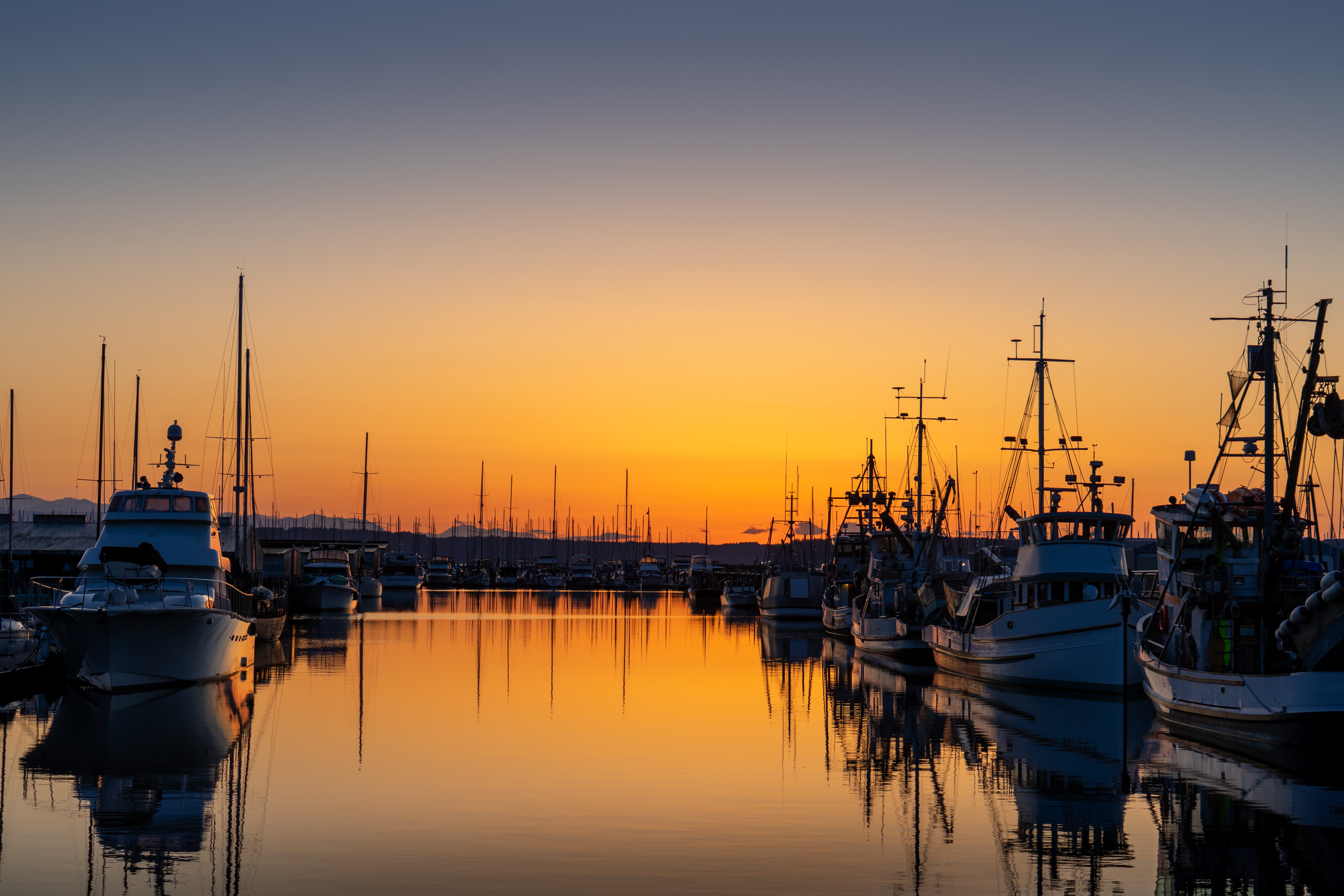
Sunset over the Everett Marina
Moored boats at the Port of Everett, WA
Population
About 114,700 residents (Washington OFM estimate, April 2025), the largest city in Snohomish County
Typical commute
About 25 to 30 minutes to Seattle off-peak, 50 to 90 minutes at peak; Sounder rail links Everett Station to Seattle
Schools
Everett Public Schools serves the city, with Everett High (est. 1891), Cascade High, and Jackson High
Where it sits
ZIPs 98201, 98203, 98204, and 98208, on Port Gardner Bay at the mouth of the Snohomish River
// The honest trade-offs
Relocating to Everett: The Quick View
Everett is a real city with a real waterfront, and it is honest about what that means. You get jobs, transit, historic neighborhoods, and the west coast’s largest public marina, and you trade some polish and a heavier commute for the price of entry. Here is the quick view, straight, so you can decide whether it fits.
Why people move here
A working waterfront that is actually for everyone
The Port of Everett runs the largest public marina on the West Coast, with about 2,300 slips, and the Waterfront Place redevelopment has turned reclaimed land into restaurants, parks, and housing. In summer, Jetty Island Days put a real sandy beach a short ferry ride from the marina.
Real jobs anchor the economy
Boeing's Everett factory, the largest building in the world by volume, sits at nearby Paine Field. Naval Station Everett homeports destroyers and Coast Guard cutters, and the Port's shipping terminals and marine trades add thousands more jobs. Employment is local enough that you can live where you work.
Distinct neighborhoods, not one big suburb
Historic Delta bungalows, bluff-top Boulevard Bluffs, lakefront Silver Lake, and downtown condos all sit inside one city. Everett is really a collection of towns with one address, and you get to choose the character.
Big-city amenities at more accessible prices
Angel of the Winds Arena brings WHL hockey and concerts to 10,000-seat crowds, the Imagine Children’s Museum is the largest in the Pacific Northwest, and Sounder rail puts Seattle a train ride away. All of it at prices well below the Seattle market.
The honest trade-offs
I-5 traffic is the price of the location
The freeway runs straight through town, and the stretch between Everett and Seattle is one of the most congested commutes in the region, especially southbound at peak hours. Sounder rail helps, but the road is the road.
The housing stock is older and uneven
Much of Everett was built before World War II, and condition varies block to block. Some neighborhoods sit beautifully maintained while nearby homes need real work, so a builder’s eye and a good inspection matter more here than in new-construction suburbs.
Pockets of the core are still finding their footing
Downtown and a few commercial corridors have come a long way, but some blocks are still filling in, and the difference between one street and the next can be sharp. Buyers need to see the specific block, not just the ZIP.
Gray marine weather is part of the package
Everett gets the Puget Sound lowlands’ share of overcast drizzle, and winters run gray and short. The payoff is marina sunsets, mountain views, and mild summers, but the clouds are honest about their presence.
// The commute, honestly
Commuting from Everett: the honest picture
Everett is both a destination and a origin city: thousands of county residents drive into it for work, and thousands more commute out of it to Seattle and the Eastside. That makes I-5 the defining feature. The ranges below are approximate weekday figures that swing with departure time, weather, and incidents; treat them as planning numbers, not promises.
| Destination | Main route | Off-peak | Rush hour |
|---|---|---|---|
| Seattle | I-5 south | About 25 to 30 minutes | About 50 to 90 minutes; WSDOT logged about 54 minutes in general-purpose lanes on a recent Monday morning |
| Bellevue | I-5 to I-405 | About 25 to 30 minutes | About 60 to 90 minutes in the worst of peak |
| Redmond / Eastside tech | I-5 to I-405 to SR-520 | About 35 to 45 minutes | About 60 to 90 minutes |
| Boeing / Paine Field | Local streets; SR-526 | About 10 to 20 minutes from most of the city | Add shift-change queues near the plant |
Approximate ranges drawn from WSDOT travel-time data and local commuter reports. WSDOT’s reliability data suggests planning about 79 minutes in the general-purpose lanes to arrive in Seattle on time 19 of 20 days. WSDOT I-5 dashboard
Sounder & Everett Station
Sounder’s N Line runs four round trips on weekdays, about 59 minutes to Seattle’s King Street Station. Everett Station also anchors Sound Transit Express routes 510, 512, and 513, along with Community Transit locals, and offers park-and-ride, with more lots at Mariner, McCollum Park, and South Everett Freeway.
Sounder N LineLink light rail
Link’s 1 Line reached Lynnwood City Center on August 30, 2024, about 15 to 20 minutes south on I-5, and Express 512 connects Everett Station there all day. The planned Everett Link extension would run light rail up I-5, reaching southwest Everett around 2037 and Everett Station around 2041.
Everett Link statusSwift BRT & express buses
Community Transit’s Swift lines cover the county: Blue runs Everett to Shoreline/185th, Green links the Boeing plant to Canyon Park, and Orange runs Lynnwood to Mill Creek. Express 532 serves downtown Bellevue and 535 links Lynnwood to Bellevue and the Link 2 Line.
Swift lines// Prices, dated and sourced
What homes cost in Everett
Everett is the county’s most varied market, and the median only tells part of the story. The figures below are dated, sourced snapshots; your exact costs depend on the neighborhood, the property, and the market on the day you buy.
City median home value
$619,916
Zillow Home Values, September 2026
City medians are a monthly snapshot, refreshed monthly, and they differ from the countywide NWMLS median.
| Measure | Everett | Comparison | Source |
|---|---|---|---|
| Median sale price, all homes | One of the county's more affordable city markets in 2026, with typical sales running well below the county-wide median | County-wide median about $720,000 (Sept 2026) | Qualitative, MLS sales data |
| Median single-family home | Single-family sales in 2026 have run below the county-wide single-family range | Below the county-wide single-family range | Qualitative, MLS sales data |
| Median condo / townhome | Among the county's most affordable entry points into ownership in 2026 | The county’s most affordable entry into ownership | Qualitative, MLS sales data |
| Typical housing type & lot | Older single-family stock in Delta, Riverside, and Northwest Everett; lakefront around Silver Lake; condos downtown | Condition varies block to block | MLS & city data, qualitative |
| HOA prevalence | Condos and newer townhomes nearly always; most single-family neighborhoods no | Downtown condos carry dues and reserves | Disclosed per property |
County-wide median of about $720,000 for September 2026 is per the NWMLS market snapshot published October 6, 2026. NWMLS market snapshot
What the dollar buys
Everett’s median runs well below the county-wide median, which is exactly why buyers priced out of Snohomish, Lake Stevens, and the south county land here. The trade-off is the stock: much of it predates World War II, so the same square footage can mean very different condition, systems, and budgets from one block to the next. Northwest Everett and Boulevard Bluffs carry premiums for character and views, Silver Lake holds steady for lakefront, and downtown condos and lofts remain the most affordable entry point.
How buying works here
This is a shop-the-block market: the same ZIP can hide a beautifully maintained bungalow next to a house needing real work, so location and inspection matter more than in new-construction suburbs. Curt’s construction background gives you a builder’s read on foundations, roofs, electrical, and plumbing before you bid. Condos also resell slower than single-family homes, so downtown buyers have more room to be deliberate.
// Before you make an offer
Everett-specific things to check before you buy
A waterfront delta location, older housing stock, and a dense urban grid give Everett its own set of checks. These are the ones that come up most often. Requirements vary by property and address, so treat this list as a starting point, not an answer for a specific lot.
Flood zones at the delta
Everett sits on Port Gardner Bay at the Snohomish River delta, and the low-lying coastal areas are mapped in FEMA flood zones. Look up the exact address on the FEMA Flood Map Service Center and on the city’s hazards map before you make an offer.
City hazard mapWetlands & critical areas
Wetlands, streams, and frequently flooded areas are regulated critical areas under the city’s code, with buffers based on wetland category. The city is updating those rules, so current maps and buffer tables matter. Lots on or near a critical area typically need a study before development.
Critical area updateADUs
Everett allows up to two accessory dwelling units per lot (one attached, one detached) in most zones, with no owner-occupancy requirement; detached units are capped at about 1,000 square feet. Permits, setbacks, and utility capacity still apply, so confirm the rules for the specific address.
Everett ADU rulesOlder housing stock
Much of Everett was built before World War II, and condition varies sharply. Budget for an inspection that covers foundation, roof, electrical, plumbing, and any previous remodel work. A builder’s eye separates charm from a money pit better than any price-per-square-foot comparison.
Get a property readSeismic & ground conditions
The city sits in the Puget Sound seismic zone, and the river-delta lowlands include ground prone to liquefaction in a quake. Older homes may benefit from foundation and seismic-retrofit review, and new construction follows the current code. Ask about retrofit history on any pre-war home.
Ask about the specific lot
Flood, wetland, and building rules all come down to the exact parcel. Curt runs these checks for every buyer and can tell you what applies to a property before you spend money on it.
Ask Curt about a property// Where you would actually live
Neighborhoods in and around Everett
Everett is the county’s most neighborhood-driven market. From the brick historic core to the flat river districts, the bluff-top historic homes, and the lakefront east side, each pocket has its own housing, its own schools, and its own price range. Buyers here shop neighborhoods first and Everett second, and it pays to do the same.
Historic downtown and Hewitt Avenue
The National Register Hewitt Avenue Historic District anchors the core: Prohibition-era brick buildings, the 1901 Historic Everett Theatre, and a growing mix of condos, lofts, cafes, and events. It is the most walkable address in the county, with Sounder rail at Everett Station a few blocks away.
Delta and Riverside
Everett's oldest residential districts, flat along the Snohomish River. Delta holds 1920s Craftsman bungalows, including houses built for Weyerhaeuser mill workers in 1916, and Riverside's tree-lined streets circle Garfield Park close to the restaurants and shops on Broadway.
Bayside and Port Gardner
The waterfront neighborhoods wrapped around the marina: views of the Olympic Mountains and Port Gardner Bay, Clark Park, historic apartment buildings like the Olympian, and new condos steps from Waterfront Place. Rucker Hill rises above, where the old mansions keep the best water views.
Northwest Everett and Silver Lake
Established neighborhoods with some of the city’s strongest demand. Boulevard Bluffs and the Craftsman-and-Tudor historic streets west of downtown carry the premiums, while Silver Lake, with its lakefront parks and newer homes, anchors a popular east-side enclave.
// Water, parks, and play
Parks, the water, and room to play
The water is the whole point of Everett. A 197-acre forest park, a bluff-top vantage over the bay, the largest public marina on the West Coast, and a ferry ride to a man-made beach all sit within minutes of downtown. Recreation here is built around Port Gardner Bay, and residents use it.
Grand Avenue Park
A bluff-top park with one of the best views in the county: Port Gardner Bay, the marina, and Naval Station Everett laid out below. The Grand Avenue Park pedestrian bridge, an Everett icon, connects the bluff down to the waterfront and the rail trail.
Forest Park
Everett's largest park at 197 acres, with miles of wooded trails, a petting zoo, playgrounds, a summer splash pad, and an indoor swim center. Much of its stonework and landscaping dates to WPA crews in the 1930s.
Jetty Island
A two-mile, man-made island that doubles as Everett’s summer beach. During Jetty Island Days, a passenger ferry runs from the Port’s Jetty Landing, and the island’s sandbars, shallow water, and warm-water lagoons are a family favorite all season.
The marina and Waterfront Place
The largest public marina on the West Coast, with about 2,300 slips, a working shipyard, and a growing waterfront promenade of restaurants, parks, and boat watching. The Port keeps more than half of its roughly 3,000 waterfront acres open to the public.
// Hewitt Avenue and the historic core
Downtown: a historic boom town with new energy
Everett was platted in 1890 as a planned industrial boom town and incorporated on May 4, 1893, named for Everett Colby, the son of one of its East Coast backers. Dozens of sawmills and shingle mills earned it the nickname the City of Smokestacks, and the brick storefronts from that boom era still line Hewitt Avenue. The Hewitt Avenue National Historic District, listed on the National Register in 2010, holds the highest concentration of historic buildings in the city, and the Historic Everett Theatre has run shows since it opened in 1901.
Today downtown is the county’s arts and events core. Imagine Children’s Museum fills three floors plus a rooftop playground, Angel of the Winds Arena brings WHL hockey and concerts to 10,000-seat crowds, and the Sunday farmers market lines Wetmore Avenue through the season. Add the Fisherman’s Village Music Festival in May and Sorticulture in June, and the old boom town has become the place the county gathers.
Local spots to know
- Narrative Coffee Coffee roaster and cafe on Wetmore Avenue
- Makario Coffee Roasters Coffee roaster and shop on Colby Avenue
- Catalyst Café Cafe, music, and kitchen on Hewitt Avenue
- Scuttlebutt Brewing Longtime Everett brewery with a restaurant and pub at the waterfront
- At Large Brewing & Taproom Brewery and taproom on West Marine View Drive
- The Independent Beer Bar Craft beer bar on Hewitt Avenue
- Imagine Children’s Museum Three floors of exhibits plus a rooftop playground on Wall Street
- Angel of the Winds Arena Home of the Everett Silvertips, concerts, and events on Hewitt Avenue
// The honest trade-offs, city to city
How Everett compares to its neighbors
Everett is the county’s big city, and the honest comparisons run against the Sound-side and corridor towns around it. Straight reads, no marketing.
vs. Mukilteo
Mukilteo is the waterfront Sound-side village with the ferry, higher prices per square foot, and a quieter bedroom character. Everett gives you jobs, Sounder rail, the arena, and the working waterfront for less per square foot, along with more rental variety and a denser feel. Pick Mukilteo for the ferry-and-view lifestyle; pick Everett for value, transit, and energy.
Read the Mukilteo guidevs. Lynnwood
Lynnwood is the retail and mall hub of the south county, with Link rail now landing at its City Center and a newer, more suburban housing mix. Everett keeps the waterfront, the historic core, and more working neighborhoods, and it is closer to nothing you actually need to drive for. Lynnwood wins on mall-adjacent convenience and south-county access; Everett wins on character and a real downtown.
Read the Lynnwood guidevs. Marysville
Marysville to the north is the value market: more land, newer construction, and a shorter corridor commute to Everett itself, with prices below the county median. Everett delivers the waterfront, Sounder rail, and the densest set of neighborhoods, but with older housing stock and heavier traffic. Lake Stevens, to the east, is the lake-town alternative with the longest Seattle commute of the three, and Snohomish is the heritage river town off the freeway.
// Day-to-day life
Everyday life in Everett
Shopping & dining
Hewitt Avenue holds the dining, bars, and coffee scene, the marina adds waterfront restaurants, and the Sunday farmers market lines Wetmore Avenue in season. Everett Mall and the north-end retail corridors cover everyday shopping, and downtown is genuinely walkable by county standards.
City parks & facilitiesHealthcare
Providence Regional Medical Center Everett is the county’s full regional and trauma center, right in the city, and Swedish Mill Creek Campus anchors the south end with a 24/7 emergency room. Urgent-care clinics and primary-care offices sit throughout the city, so serious care is never far.
Providence EverettLibrary & community
The Everett Public Library serves the city from its Main Library on Hoyt Avenue and the Evergreen Branch, separate from the Sno-Isle system that covers the rest of the county. Between the library, Imagine Children’s Museum, Angel of the Winds Arena, and a calendar of downtown festivals, there is genuine big-city programming here.
Everett Public Library// How the city works day to day
Local info: schools, events, and getting around
Schools
Everett Public Schools (School District No. 2) serves the city and parts of Mill Creek, with four comprehensive high schools: Everett High, founded in 1891, Cascade, Henry M. Jackson, and Sequoia. Residents on the city’s south and east edges also draw on the Mukilteo School District, so school attendance is very much an address-by-address question here. Match a specific address to its district and assigned school before you buy. Higher ed is local: Everett Community College and WSU Everett both sit inside the city.
Getting around
I-5 runs straight through town, US-2 heads east over Stevens Pass, and the Mukilteo ferry is a short drive south. Everett Station links the city to Seattle on Sounder commuter rail, Community Transit and Swift BRT cover the county, and downtown, Bayside, and the waterfront are genuinely walkable by design. Link light rail now waits at Lynnwood City Center about 15 to 20 minutes south.
Community character
Everett grew from sawmills into one of the state’s industrial anchors: Boeing’s Everett factory, the largest building in the world by volume, sits at nearby Paine Field, and Naval Station Everett has homeported destroyers and Coast Guard cutters since it commissioned in 1994. The Snohomish, Tulalip, and Stillaguamish peoples have lived on these waters for thousands of years, and the waterfront connects all of it.
Mark the calendar
Everett Farmers Market
Sundays on Wetmore Avenue in downtown from spring through October. The 2026 season is the market’s 33rd, with local produce, food vendors, and live music every week.
Fisherman’s Village Music Festival
Downtown Everett’s multi-day music and arts festival each May, with 50-plus performances by national and regional artists across venues within walking distance of each other.
Sorticulture
The City’s garden arts festival each June: more than 100 artists, plant specialists, garden art, clinics, and live music filling the downtown core.
// Everett relocation FAQ
Questions people ask about Everett
These are the Everett-specific questions Curt hears from buyers weighing a move. The county-wide questions, on rates, equity, and selling first, live on the main FAQ page.
01 I want waterfront. What does living on the water in Everett actually cost?
Waterfront and water-view homes in Bayside, Port Gardner, and the historic bluff neighborhoods carry a clear premium over the city median, and many are condos in marina-adjacent buildings with HOAs and special-assessment risk. Compare the marina condos against bluff-top houses, and budget for marine maintenance and exposure before you commit.
02 Is commuting to Seattle from Everett really as bad as people say?
Off-peak it is about 25 to 30 minutes, but peak can run 50 to 90 minutes on I-5. The Sounder is the reliable alternative: about 59 minutes to King Street Station on weekdays. Plan your schedule around the train or the off-peak window and Everett is far easier to love than the worst-case story suggests.
03 Are downtown Everett condos a smart first purchase?
Downtown condos are the most affordable entry into the city, often in the mid-$300,000s to $400,000s, but they resell slower than single-family homes and carry HOA dues plus special-assessment risk. Buy for the building quality and the lifestyle, not for fast appreciation, and review the reserve study before you make an offer.
04 How do I know which school district a specific Everett home is in?
Everett Public Schools serves most of the city, but parts of the south and east edges draw on the Mukilteo School District, so school assignment is very much an address-by-address question. Confirm the district for the exact property, then the assigned school, before you commit.
05 Should I worry about flooding near the Snohomish River or the bay?
The low-lying river delta and bayfront are mapped in FEMA flood zones, and the city treats frequently flooded areas as regulated critical areas. Check the FEMA flood map for the specific address and ask about flood insurance history. Bluff and high-ground neighborhoods sit outside the floodplain entirely.
06 Is there a bus or rail option to Bellevue or Redmond from Everett?
Sound Transit Express 532 runs Everett to downtown Bellevue on weekdays, and 535 links Lynnwood to Bellevue and the Link 2 Line, where you can transfer toward Redmond. Most of those are weekday-peak services, so check current schedules on Sound Transit’s site before you plan around them.
Still deciding?
Curt has sold all over Snohomish County since 2003 and knows Everett block by block. Ask him your specific question, free and pressure-free.
// The county’s most varied market
Thinking about Everett?
Everett is the most varied market in the county, and the numbers reflect it. In late 2026, market data put the city’s median sale price around $600,000, with most homes selling in roughly one to two weeks and typically drawing multiple offers below the $750,000 range. That sits below the county-wide median of about $720,000, which is why so many buyers priced out of Snohomish, Lake Stevens, and the south county land here.
Where you buy changes the number dramatically. Historic Northwest Everett and Boulevard Bluffs carry premiums in the $700,000 to $900,000 range for character homes and water views, Silver Lake holds steady in the high $600,000s, and downtown condos and lofts remain the most affordable entry point, with median condo prices in the mid-$300,000s. Condos also move the slowest, so downtown buyers have more time than they do in the single-family neighborhoods.
Curt has sold real estate across Snohomish County since 2003 and knows Everett block by block: which neighborhood fits which buyer, how the school districts and transit access move demand, and how to position a listing against the newest construction nearby. His construction background matters here too, because Everett’s older housing stock comes with real questions about condition, systems, and what is worth fixing before a sale.
Everett sits in ZIPs 98201, 98203, 98204, and 98208 at the mouth of the Snohomish River on Port Gardner Bay, about 30 miles north of Seattle on I-5. Ask Curt about historic Northwest Everett, waterfront condos, Silver Lake, or move-up homes on the established east side.
More community guides