
// Washington’s first modern planned city · Town Center lifestyle
Mill Creek
A master-planned city built around a golf course and trail system, with a town center that gives it a real downtown.
Mill Creek is a master-planned city in the southeast corner of Snohomish County, about 20 miles north of Seattle and 10 miles south of Everett. It is Washington’s first modern planned community, built from the late 1970s around an 18-hole golf course, a wooded trail system, and neighborhood parks, and it incorporated as a city on September 30, 1983. Today about 21,600 people call it home, per the state Office of Financial Management’s April 1, 2026 estimate, and the Mill Creek Town Center gives the city the downtown it was designed without. This guide covers Mill Creek’s neighborhoods, parks and trails, the Town Center, schools, and the real estate picture for anyone considering a move here.
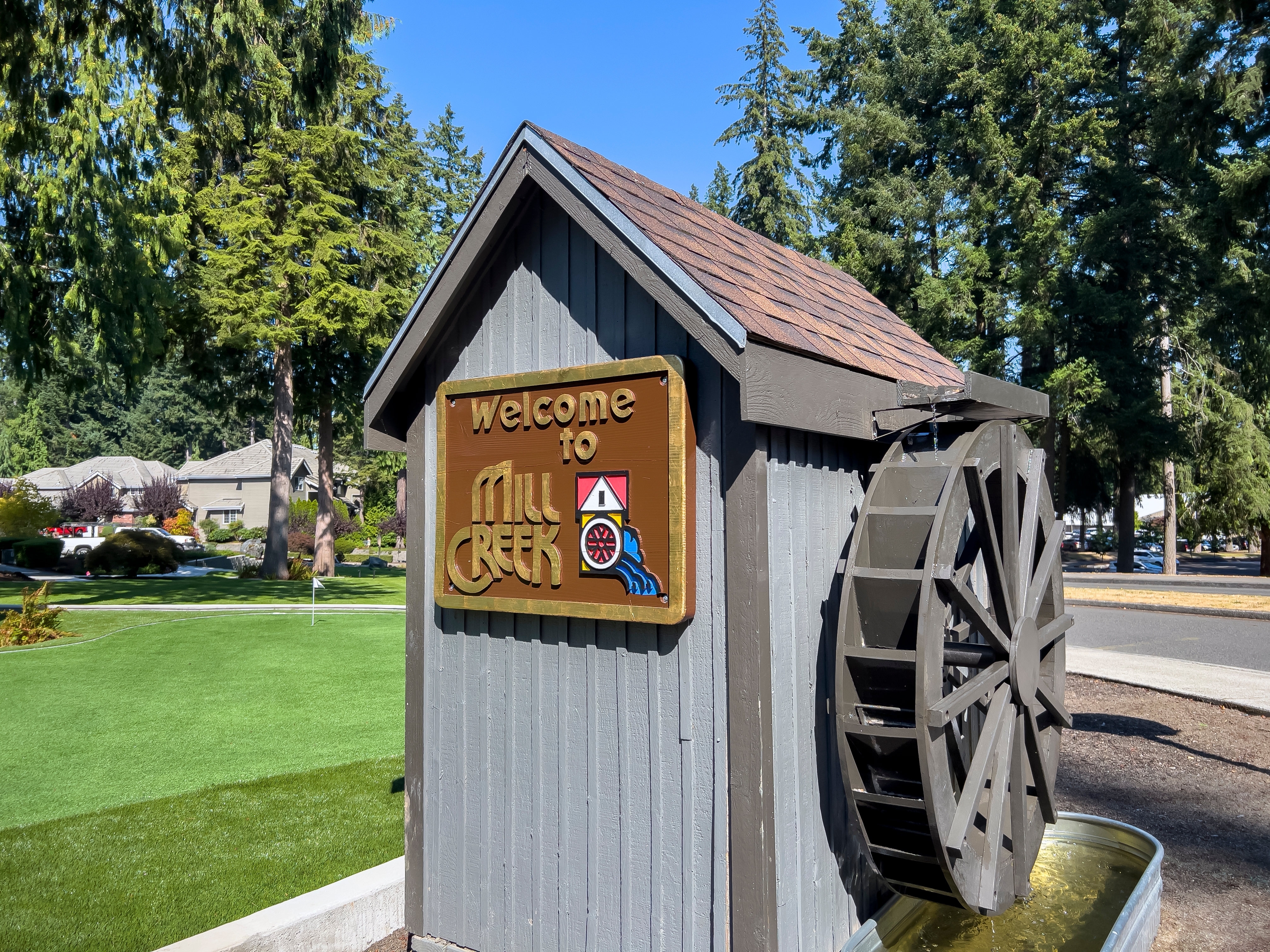
The “Welcome to Mill Creek” sign
Landmark entrance at the gateway into the city · Mill Creek, WA
Population
About 21,600 people (WA Office of Financial Management estimate, April 1, 2026: 21,630; 2020 Census: 20,926)
Typical commute
About 15 minutes to Everett; 30 to 40 minutes to Seattle off-peak, longer at peak on I-5; 35 to 40 minutes to Bellevue and the Eastside
Schools
The Everett School District serves the city, with Mill Creek Elementary, Heatherwood and Gateway Middle, and Henry M. Jackson High
Where it sits
ZIP 98012, in the southeast corner of Snohomish County along the Bothell-Everett Highway, about 20 miles north of Seattle
// The honest trade-offs
Relocating to Mill Creek: The Quick View
Mill Creek is the county’s planned-community success story: tree-lined streets, a private golf course at its center, a trail network that reaches into every corner, and a Town Center that supplies the downtown the city was never built with. It is also one of the pricier and more competitive markets in Snohomish County, with covenants and commutes that are part of the deal. Here is the quick view, straight, so you can decide whether it fits.
Why people move here
A town center that gives the city a downtown
Mill Creek was designed in the 1970s without a downtown, so the Town Center, which opened in 2004 on Main Street, filled that gap. It is an open-air lifestyle center with roughly 88 shops, restaurants, and services, built around pedestrian walkways and courtyards and anchored by Central Market and a University of Washington Bookstore. It was named Washington’s Best Lifestyle Center and Open-Air Mall in 2013, and it is where the city’s concerts, festivals, and holiday events happen.
The golf-course heart of the city
The original planned community was centered on the Mill Creek Country Club, an 18-hole Ted Robinson course that opened in 1976 and was built to preserve the heavily wooded terrain. The namesake Mill Creek stream winds through most holes, and the Country Club neighborhood’s fairway, green, and creekside homes remain the most sought-after addresses in the city.
A trail system that threads the whole city
The North Creek Trail runs along North Creek from the regional system up into Mill Creek, part of a roughly 10-mile paved link between Everett, Mill Creek, and Bothell, and neighborhood nature trails reach into most corners of town. Add Library Park at the edge of the Town Center, the skate park at Mill Creek Sports Park, and county-run Tambark Creek Park with its off-leash dog area, and recreation is rarely more than a short walk or drive away.
In-town schools in the Everett School District
The Everett School District serves all of Mill Creek, with the main feeder pattern running from Mill Creek Elementary through Heatherwood Middle to Henry M. Jackson High. Student assignment follows the home address, so verify a specific property with the district.
The honest trade-offs
The commute is the honest trade-off
Mill Creek sits about 20 miles north of Seattle, so a drive into the city runs 30 to 40 minutes off-peak and 45 to 60 minutes or more at peak on I-5, with no rail stop in town. Everett is about 15 minutes and the Eastside roughly 35 to 40, but if your job is in Seattle, budget for traffic.
Premium prices in a cooling market
Mill Creek is one of the most expensive markets in the county. In 2026, NWMLS data put the median sale price around $975,000, with typical home values near $950,000 to $970,000, and most single-family homes running $850,000 to $1.3 million, from condos and townhomes in the $575,000 range to executive homes over $1.5 million. Prices have been roughly flat to slightly down year over year after the 2024 peak, but it is still a competitive market.
A retail town center, not a traditional downtown
The Town Center is a designed lifestyle center, not an old main street, and it is the only real walking district in town. Everything else, from groceries to services, sits along the Bothell-Everett Highway corridor, so most errands are a short drive rather than a walk from your door.
Covenants and community association rules
Because Mill Creek was built as a planned community, much of the city is governed by the Mill Creek Community Association and neighborhood HOAs, with dues, covenants, and design standards. Buyers should know what the rules and fees are before they fall in love with a lot.
// Where you would actually live
Neighborhoods in and around Mill Creek
Mill Creek’s housing story is a planned-community one: mature, heavily landscaped neighborhoods laid out from the 1970s on, with a golf course at the center and newer construction on the edges. The Country Club neighborhood holds the original fairway homes, Town Center puts you steps from the shops and restaurants, Gateway marks the old entrance to the city, and the newer edges trade a little convenience for larger lots. Almost everything is single-family homes, with townhomes and condos concentrated near the Town Center.
Country Club
The original planned community, built around the 18-hole Mill Creek Country Club and its Ted Robinson course. Fairway, green, and creekside homes on heavily wooded lots are the most established and sought-after addresses in the city, with the club at 15500 Country Club Drive as the neighborhood anchor.
Town Center
The core neighborhood around the Town Center lifestyle complex on Main Street, with condos and townhomes above and beside the shops and restaurants, plus nearby single-family streets. It is the most walkable address in Mill Creek and the closest thing the city has to downtown living.
Gateway / East Gateway
The eastern gateway at the 164th Street and Bothell-Everett Highway corner, the old Wintermute’s Corner entrance to the city and where the “Welcome to Mill Creek” sign greets arrivals. Gateway Middle School sits just outside the city limits, and the surrounding streets mix established homes with the retail of the 164th corridor.
The newer edges
The northern and eastern reaches of the city and its borders, where newer construction, larger lots, and quieter streets open up. These neighborhoods are more car-dependent, but they trade a short drive to the Town Center for more space and newer homes.
// The daily drive
The commute reality from Mill Creek
Mill Creek sits on the Bothell-Everett Highway (State Route 527), about 10 miles south of Everett and 20 miles north of Seattle, with I-5 roughly 5 to 10 minutes west and I-405 about the same to the east through Bothell. Times below are approximations for average conditions; they vary by day, hour, route, and season, and rush hour changes everything.
| Destination | Drive, off-peak | Rush hour | Transit / notes |
|---|---|---|---|
| Everett | About 15 minutes | 20 to 30 minutes | Swift Green Line toward Seaway Transit Center, then Swift Blue Line to Everett Station |
| Downtown Seattle | 30 to 40 minutes | 45 to 60+ minutes | Community Transit locals and the Swift Orange Line to Lynnwood City Center or Mountlake Terrace, then Link 1 Line (about 28 minutes from Mountlake Terrace) |
| Bellevue / Redmond | 35 to 40 minutes | 50 to 70 minutes | I-405 via Bothell; no direct transit |
| Boeing Everett / Paine Field | 15 to 20 minutes | 25 to 35 minutes | Swift Green Line to Seaway Transit Center, or drive via Airport Road |
These are approximate ranges for typical conditions, not promises. Verify your trip with WSDOT traffic and current transit schedules before you plan around it.
Transit today: Swift, buses, and a rail transfer
Mill Creek has no park-and-ride or rail stop of its own. The Swift Green Line runs from the Seaway Transit Center near Boeing Everett to Canyon Park in Bothell, with a stop at the Mill Creek Town Center; the Swift Orange Line opened March 2024 and connects Edmonds College, Lynnwood, Mill Creek, and McCollum Park. Local routes such as 106, 109, and 166 fill in the neighborhoods, and the big regional lots nearby are Ash Way, Mariner, McCollum Park, and Canyon Park. Community Transit restructured its Seattle service when Link reached Lynnwood in 2024, so the fastest rail route today is a bus to Lynnwood City Center or Mountlake Terrace Station, then Link light rail.
Honest rush-hour context
I-5 through Lynnwood, the Bothell-Everett Highway itself, and the 164th and 132nd street corridors all back up at peak. A 30-minute Seattle drive can run well past 45 at rush hour, and I-405 adds its own congestion on the Eastside leg. If your job is tied to 9-to-5 Seattle hours, budget the worst case, not the best, and know that the rail option exists even though it begins with a bus ride.
// What housing costs
Housing and buying in Mill Creek
The dated county anchor: the median sale price for Snohomish County homes and condos was about $720,000 in September 2026 (NWMLS market snapshot). Mill Creek has sold above that county figure for years: the planned setting, the golf course, the trails, the Town Center, and the address-based school assignment system in the Everett School District all carry a premium. NWMLS county press releases do not publish city-level medians, so the exact monthly number for Mill Creek moves with what sells, and the honest summary is that most Mill Creek single-family sales land above the county median, often well above.
City median home value
$967,807
Zillow Home Values, July 2026
City medians are a monthly snapshot, refreshed monthly, and they differ from the countywide NWMLS median.
| Factor | Mill Creek | County context |
|---|---|---|
| Housing types | Single-family homes dominate the planned neighborhoods; townhomes and condos concentrate around the Town Center, including above-retail units. | Mostly single-family countywide, with townhome and condo pockets near transit and town centers. |
| Typical lots | Mature, heavily landscaped lots in the 1970s to 1990s neighborhoods; larger, more suburban lots on the newer edges. | Lot sizes vary widely by city and zone. |
| HOA prevalence | High. Much of the city sits under Mill Creek Community Association covenants plus neighborhood HOAs, though not every neighborhood is in MCCA (Parkside, The Parks, The Reserve, The Vineyards, Brighton, Heatherwood West, and Highlands do not pay MCCA dues). | Common in planned communities and newer subdivisions countywide. |
| New construction | Limited inside the city; most new product sits on the northern and eastern edges and just outside the limits. | Active in much of the county; Mill Creek is largely built out. |
Live comps beat averages
City-level medians are not published in NWMLS press data, and a planned city with modest monthly volume makes short-term averages jumpy. Pair the dated county anchor above (NWMLS, September 2026) with current Mill Creek sales and you get the real picture. For countywide trends, see the market report, and ask Curt for a custom comparison of any two addresses you are weighing.
// The trail, the greenway, and the village green
Parks, trails, and room to play
Mill Creek was designed with the outdoors in mind. The city maintains a network of neighborhood and community parks, a greenway runs along North Creek up from the regional trail system, and county-run Tambark Creek Park sits just outside the city limits. You can be on a trail, at a playground, or on a skateboard within minutes of almost any address in town.
North Creek Trail & greenway
The city’s signature trail runs along North Creek up from McCollum Park, part of a roughly 10-mile paved link between Everett, Mill Creek, and Bothell that connects to the region’s larger trail network. Neighborhood nature trails branch off it through the city’s greenways.
Library Park
The in-town park at the edge of the Town Center on Bothell-Everett Highway, with open lawns, play areas, and the community’s gathering space for concerts and festivals. It is the closest Mill Creek comes to a village green.
Mill Creek Sports Park & neighborhood parks
Mill Creek Sports Park on North Creek Drive brings multi-purpose fields and a skate park to the city’s recreation core, while a network of neighborhood parks, from Buffalo and Cougar to Heron, Exploration, Highlands, and Nickel Creek, keeps a green space close to nearly every home.
Tambark Creek Park
Developed jointly by the city and Snohomish County and now county-run, Tambark Creek Park offers trails, playgrounds, baseball fields, a picnic shelter, and an off-leash dog area, making it a regional favorite for families and their dogs.
// A town center built to be the downtown
The Mill Creek Town Center: the downtown the city was designed without
Mill Creek was designed in the 1970s without a downtown, and the Town Center, which opened in 2004 at 15310 Main Street, was built to give the city one. It is an open-air lifestyle center of roughly 88 shops, restaurants, and services arranged around pedestrian walkways and courtyards, meant to evoke a Main Street of an earlier era. Central Market and a University of Washington Bookstore anchor the complex, and the city’s summer concerts, festival, and holidays on Main all land here.
The Town Center was named Washington’s Official Best Lifestyle Center and Open-Air Mall in 2013, and it holds up as a place to spend an afternoon: a courtyard, an outdoor fireplace and fountain, restaurants with patio seating, and events that keep it busy beyond shopping hours. Around it, Main Street and the Bothell-Everett Highway corridor hold the grocery stores, services, and retail the city relies on for everyday errands.
Local spots to know
- Azul Restaurant Latin American kitchen on Main Street at the Town Center
- Saw Mill Cafe Longtime cafe on Main Street
- Tablas Woodstone Taverna Mediterranean taverna on Main Street
- Claypit Cuisine of India Indian restaurant on Main Street
- Rusty Pelican Cafe Breakfast and lunch cafe on Mill Creek Boulevard
- La Palmera Family Mexican Restaurant Family Mexican restaurant on Main Street
- Hot Iron Mongolian Grill Build-your-own Mongolian grill on Main Street
- Elliott Bay Pizza & Pub Neighborhood pizza pub on 164th Street SE
// How the city works day to day
Local info: schools, events, and getting around
Schools
The Everett School District serves all of Mill Creek. Mill Creek Elementary feeds into Heatherwood Middle, with Gateway Middle nearby, and Henry M. Jackson High School serves the city’s high school students. It is worth matching a home address to its assigned school before you buy, because assignments are address-based and boundaries can shift. The Mill Creek premium is tied to the planned neighborhoods, the Town Center, and the golf course setting.
Nearby higher education includes the University of Washington Bothell and Cascadia College in Bothell, about 10 minutes away, with Edmonds College and Everett Community College within roughly 15 to 20 minutes.
Everett School DistrictGetting around
Bothell-Everett Highway (State Route 527) runs through the city, with I-5 about 5 to 10 minutes west. Everett is roughly 15 minutes, Seattle 30 to 40 minutes off-peak and longer at peak on I-5, and Bellevue and the Eastside about 35 to 40 minutes. Community Transit serves the city, and the Town Center and Library Park area are the walkable core.
Community character
Mill Creek is Washington’s first modern planned city. The project began as “Olympus” in 1966 near Wintermute’s Corner, was developed from 1974 by the United Development Corporation as roughly 4,600 residences around an 18-hole golf course, and welcomed its first residents in 1976. The city incorporated on September 30, 1983, Snohomish County’s first new city since Brier in 1965, and it has stayed true to the original tree-lined, master-planned vision.
Mark the calendar
Mill Creek Festival & Street Fair
The city’s signature summer event, held each mid-July on Mill Creek Boulevard and 161st Street. The 2026 edition, its 25th anniversary, drew about 20,000 people for juried arts and crafts, food booths, a car show, live entertainment, a Kids Korner, and beer and wine gardens.
Concerts in the Park at the Town Center
Free outdoor concerts most Wednesday evenings from July through September at the Town Center’s outdoor plaza, with jazz, R&B, and rock drawing families and neighbors to the heart of the city.
Mill Creek Farmers Market
A seasonal market at City Hall North on Main Street with fresh produce, artisan goods, and handmade crafts, on a calendar that also fills the year with Trunk-or-Treat on Main for Halloween and Holidays on Main with Santa in December.
// Neighbor to neighbor
How Mill Creek compares with its neighbors
Bothell rebuilt a walkable downtown on the Sammamish River, sits right on I-405, and hosts UW Bothell and Cascadia College, so Eastside and Seattle commutes run a little easier from there. Mill Creek is the quieter, planned alternative: golf course, trails, and Town Center, usually at a premium per square foot and with less of a downtown feel.
Everett is the county seat and the urban option: a working waterfront, Sounder rail, a naval station, more rental and condo variety, and prices below Mill Creek's. Mill Creek is the suburban planned-community counterpoint, with the Town Center, the trails, and the golf course as the draw, at a higher price.
Lynnwood has light rail in town, Alderwood retail, and more condos and townhomes. Mill Creek is more purely residential and planned, with the golf course and trails, and it typically carries a higher price per square foot for the same era of home.
No single town is best for everyone; it comes down to your addresses, commutes, and budget. If light rail matters most, read the Mountlake Terrace guide. If land and river access matter more, the Gold Bar and Sultan guides cover that end of the county, and the countywide relocation guide pulls it all together.
// What to check before you buy
Local property and buying considerations
Every address carries its own questions, and Mill Creek's come mostly from its roots as a 1970s planned community. Requirements vary by property, so verify the specifics for the exact home with the city, the association, and your own inspector.
Covenants and community rules
Most of Mill Creek is governed by the Mill Creek Community Association's amended and restated declaration of restrictive covenants plus neighborhood HOAs, with architectural review, maintenance standards, and dues. Not every address is in MCCA, so read the documents that actually apply to the house before you offer.
Mill Creek Community AssociationCreeks, wetlands, and buffers
North Creek and the city's stream corridors, wetlands, and critical aquifer recharge areas sit under the critical areas code (MCMC Chapter 18.06), updated in January 2026 with riparian management zones and a revised wetland buffer table. A home near a creek or wetland can carry buffer, setback, and mitigation limits.
Drainage and stormwater
New development and remodels that add impervious surface must meet the city's stormwater standards, with low-impact development preferred. In the older planned neighborhoods, how a home sheds water after decades of tree growth matters more than on a new lot.
ADUs and zoning
Mill Creek allows up to two accessory dwelling units per lot, attached or detached, 400 to 1,000 square feet, with no owner-occupancy requirement under state law (MCMC 17.22.130). If rental or multigenerational potential matters, check the ADU rules against the specific lot and its HOA documents.
Mill Creek Municipal Code 17.22Washington is earthquake country, and the 1970s and 1980s housing stock here predates modern seismic bracing and drainage standards. A thorough inspection with foundation, drainage, and system checks is the best money you will spend. Requirements vary by property.
// Q & A
Relocating to Mill Creek: Common Questions
Straight answers to the questions buyers actually ask about Mill Creek. If your question is not here, ask Curt directly.
Ask Curt a Mill Creek question01 Is Mill Creek a city or a neighborhood of Everett?
Mill Creek is its own incorporated city, Washington's first modern planned community, incorporated September 30, 1983. It has its own mayor, council, city hall, and planning authority; the name and geography simply overlap with nearby Everett and Bothell.
02 Do I have to join a homeowners association?
Much of the city is governed by the Mill Creek Community Association plus neighborhood HOAs, but not every neighborhood is in MCCA. Dues, covenants, and design rules vary street by street, so read the governing documents for the specific home before you make an offer.
03 How do I get to Seattle without driving?
There is no rail stop in Mill Creek. Riders take Community Transit, including the Swift Green and Orange Lines, to Lynnwood City Center or Mountlake Terrace Station and then Link light rail into Seattle, with the rail leg from Mountlake Terrace about 28 minutes. The bus-to-rail trip is a realistic commute, just not as fast as a clean highway drive.
04 What does "above the county median" mean in dollars?
The dated county anchor is about $720,000 for homes and condos (NWMLS, September 2026). Mill Creek most often sells above that, at times well above, with most single-family sales running from the high $800,000s into the seven figures depending on neighborhood. Ask Curt for current Mill Creek comps for the exact street you are considering, because averages hide a lot.
05 Which school district serves Mill Creek?
The Everett School District serves the city, with Mill Creek Elementary, Heatherwood Middle, and Henry M. Jackson High in the main feeder pattern. Assignments are address-based and can change, so verify a specific home with the district before relying on a feeder pattern.
06 What is the Town Center actually like?
It is an open-air lifestyle center, not a traditional downtown: roughly 88 shops, restaurants, and services arranged around walkways and courtyards, anchored by Central Market and a UW Bookstore, opened in 2004. The farmers market, summer concerts, festival, and holiday events all land here, and it gives the city the walkable core it was designed without.
Everyday life at a glance
- Library: Sno-Isle's Mill Creek Library on Bothell-Everett Highway, a short walk from the Town Center.
- Groceries: Central Market anchors the Town Center, with more grocery options along the highway corridor.
- Healthcare: Swedish's Mill Creek campus is in the city; Providence Regional Medical Center Everett is the full-service hospital about 15 to 20 minutes north.
- Markets and events: the Mill Creek Farmers Market at City Hall North, plus the festival and the concerts listed above, keep the Town Center busy all year.
// A planned community with a premium
Thinking about Mill Creek?
Mill Creek is the county’s planned-community showcase, and the price reflects it. In 2026, NWMLS data put the median sale price around $975,000 with typical home values near $950,000 to $970,000, while most single-family homes ran $850,000 to $1.3 million, from townhomes in the $575,000 range to executive properties over $1.5 million. Homes still sell fast, often in about 9 to 11 days with multiple offers, even as prices hold roughly flat to slightly down year over year.
Curt has sold real estate across Snohomish County since 2003 and knows Mill Creek’s planned neighborhoods block by block: which Country Club streets and Town Center buildings hold value, how the community association covenants and dues should factor into an offer, and what a 1970s or 1980s built home needs in systems and upkeep. His construction background matters here, because well-kept planned communities still age, and knowing what is worth paying for separates a good buy from a costly one.
Mill Creek sits in ZIP 98012 in the southeast corner of Snohomish County along Bothell-Everett Highway, about 20 miles north of Seattle. Ask Curt about the Country Club, Town Center, Gateway, or the newer edges of the city.
More community guides