// US-2 river valley · where the rivers meet
Monroe
The Skykomish Valley’s river town, where US-2 becomes the gateway to the Cascades.
Monroe sits where the Skykomish and Snoqualmie rivers join to form the Snohomish, and where US-2 heads east into the mountains. The U.S. Census Bureau estimated about 20,025 residents as of July 1, 2025, up from 19,699 in the 2020 Census. It pairs a genuine historic downtown with some of the best access to Cascades recreation in the county, at prices that still undercut the I-5 corridor. Curt has sold real estate across Snohomish County since 2003 and knows Monroe block by block, from the early-1900s homes around the old core to the newer developments at Fryelands to the farm country of the Tualco Valley. This guide covers Monroe’s neighborhoods, parks, downtown, schools, commutes, and the real estate picture for anyone considering a move here. Census QuickFacts
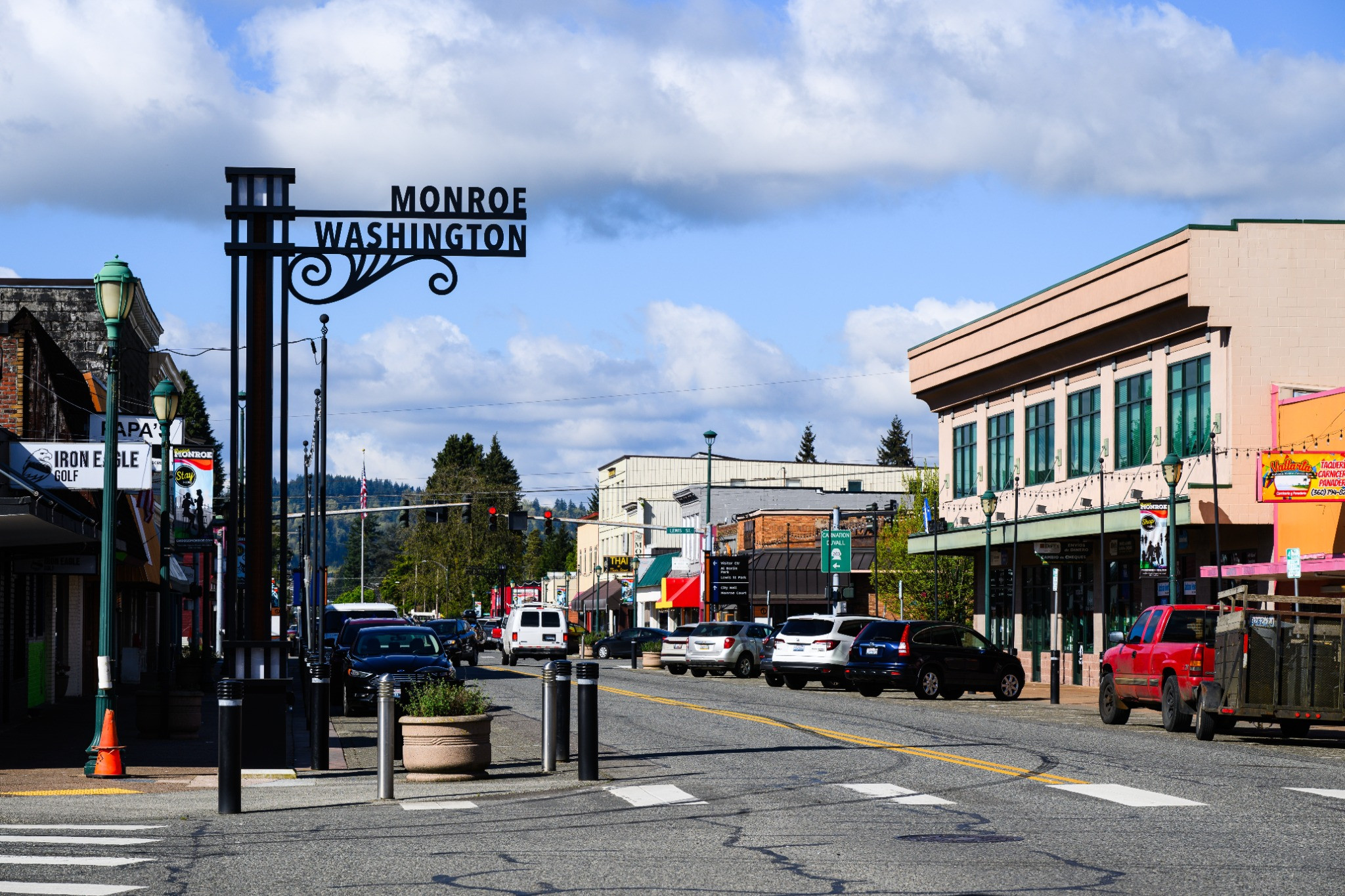
Historic downtown Monroe
Main Street, Monroe, WA
Population
About 20,000 people (2020 Census: 19,699; U.S. Census July 1, 2025 estimate: 20,025)
Typical commute
About 20 to 35 minutes to Everett on US-2; budget an hour or more to Seattle at peak times
Schools
Monroe School District serves the city, with five elementary schools, two middle schools, and Monroe High School
Where it sits
ZIP 98272, on US-2 where the Skykomish and Snoqualmie rivers join to form the Snohomish
// The honest trade-offs
Relocating to Monroe: The Quick View
No town is right for everyone, and Monroe is honest about what it is. It delivers a real small-town core, a river valley setting, and the mountain corridor at its doorstep, and it asks you to trade some commute convenience for that. Here is the quick view, straight, so you can decide whether it fits.
Why people move here
Two rivers and a valley setting
The Skykomish and Snoqualmie meet just west of town to form the Snohomish, and the parks and trails line that water. Monroe has room to breathe in a way most I-5 corridor towns don’t.
A genuine small-town core
Historic Main Street holds local restaurants, a museum in the 1908 city hall, and public art, and the river parks sit a short walk or drive away. It is a real downtown, not a strip.
Real value, in town and on acreage
Established neighborhoods, newer developments, condos and townhomes, and rural acreage in the Tualco Valley cover a wider price range than most county towns.
US-2 puts the mountains at the doorstep
Wallace Falls, the Skykomish, Index, and Stevens Pass are a short drive east, and the river gives Monroe its own outdoor identity instead of borrowing one.
The honest trade-offs
US-2 is the bottleneck
One lane each way between Monroe and Everett, and peak-hour backups plus any accident can double the drive. It is the trade everyone who lives here knows by heart.
The Seattle commute is long
On a good day the best route via SR-522 and I-405 is under an hour, but rush hour regularly pushes well past that. Daily commuters feel the corridor.
Fair month takes over the town
Late August into early September, Evergreen State Fair traffic packs US-2 and 179th Avenue SE, and the fairgrounds become the center of the county.
Growth is younger than the valley
New rooftops have arrived faster than some roads, schools, and services, and the fairgrounds and the correctional complex define a large share of local jobs.
// The commute, honestly
Commuting from Monroe: the honest picture
Monroe sits on US-2, and every commute runs through the valley corridor: US-2 west to Everett, or SR-522 toward the I-405 corridor and the Eastside. The ranges below are approximate weekday figures that swing with departure time, weather, fair-season traffic, and incidents, so treat them as planning numbers, not promises.
| Destination | Main route | Off-peak | Rush hour |
|---|---|---|---|
| Everett | US-2 west, one lane each way | About 20 to 30 minutes | About 30 to 45 minutes or more; any accident or peak-hour backup can double the drive |
| Seattle | US-2 to SR-522 / I-405, or via Everett and I-5 | About 45 to 60 minutes | About 60 to 90 minutes in the worst of peak |
| Bellevue / Redmond | SR-522 to I-405, then SR-520 or NE 8th | About 30 to 35 minutes | About 45 to 60 minutes or more |
| Boeing / Paine Field | US-2 to I-5 north | About 30 to 40 minutes | About 45 to 60 minutes; add shift-change queues near the plant |
Approximate ranges drawn from WSDOT travel-time data, routing tools, and local commuter reports; winter weather and flooding add time on US-2 and SR-522. WSDOT SR 2
Community Transit on the US-2 corridor
Route 271 runs daily from Gold Bar through Sultan and Monroe to Snohomish and Everett Station, and Route 270 is the weekday-peak express on the same US-2 corridor. From Everett Station you connect onward to Link light rail and Sounder for Seattle.
Monroe transit guideGetting to Seattle by transit
As of mid-2026 there is no direct bus from Monroe to downtown Seattle, so most riders take Route 271 to Everett Station and connect, or catch Route 908 toward Bellevue, which links to the Link 2 Line into Seattle. Rail itself reaches Monroe only through those transfers, with the closest stations at Everett and Lynnwood.
Link 2 LineMonroe Park & Ride
The park-and-ride on US-2 in Monroe anchors the daily bus service and gives local commuters a place to leave the car. For rail, drivers head to Everett Station or to the Link station at Lynnwood City Center, the northern terminus of the 1 Line. Read the Lynnwood guide for the rail-side picture.
Lynnwood guide// Prices, dated and sourced
What homes cost in Monroe
Monroe\u2019s market spans a wider band than most county towns, from first-townhome entries to five-acre farmsteads, and the median only tells part of the story. The figures below are dated, sourced snapshots; your exact costs depend on the neighborhood, the property, and the market on the day you buy.
City median home value
$722,297
Zillow Home Values, July 2026
City medians are a monthly snapshot, refreshed monthly, and they differ from the countywide NWMLS median.
| Measure | Monroe | Comparison | Source |
|---|---|---|---|
| Median sale price, all homes | Recent 2025-2026 sales have landed around the county-wide median, mostly in the $700,000s | County-wide median about $720,000 (September 2026, NWMLS) | Qualitative, MLS sales data |
| Median single-family home | Higher than the all-homes median; most single-family homes in the high-$700,000s to $800,000s | Roughly in line with, sometimes above, the county single-family range | Qualitative, MLS sales data |
| Condos & townhomes | Townhomes in the mid-$400,000s and condos below that, a real entry point into the valley | Well below the county median | MLS data, qualitative |
| Typical housing types & lots | Early-1900s character homes around Old Town, newer subdivisions at Fryelands, established areas around Chain Lake, and protected farmland and acreage in the Tualco Valley; lots run from compact in-town to multi-acre rural | A wider range than most county towns | MLS & city data, qualitative |
| HOA prevalence | Some newer developments carry HOAs; most established neighborhoods and rural acreage do not | Disclosed per property | Disclosed per property |
County-wide median of about $720,000 for September 2026 is per the NWMLS market snapshot published October 6, 2026. NWMLS market snapshot
What the dollar buys
Where you buy changes the number dramatically. Fryelands and the newer subdivisions carry most of the volume, the established areas around Chain Lake and the higher ground hold a premium, and the Tualco Valley offers acreage and rural homes that simply do not exist in most of the county. That range is the point: Monroe works for a first-townhome buyer and a five-acre seller alike.
How buying works here
Homes typically sell in about two to three weeks, and the valley floor brings real due-diligence questions: floodplain on river-adjacent lots, septic and sewer status, and wetland review on acreage. Older character homes around Old Town need a builder\u2019s eye on foundations and systems. That is exactly where Curt\u2019s construction background earns its keep.
// Before you make an offer
Monroe-specific things to check before you buy
A river-valley city with a rural farm fringe gives Monroe its own set of checks: floodplain, sewer and septic, wetlands, and accessory dwelling unit rules. These are the ones that come up most often. Requirements vary by property and address, so treat this list as a starting point, not an answer for a specific lot.
Skykomish & Woods Creek flood zones
FEMA’s 100-year floodplain hugs the lowlands along the Skykomish River and Woods Creek and the Lake Tye area, while most of the city sits outside the mapped flood zone. Properties in mapped zones on federally backed loans generally need flood insurance. Look up the exact address before you offer.
City flood programSeptic vs. city sewer
Monroe city code requires connection to public sewer once it becomes accessible, and properties annexed with a private septic system must hook up when the system fails. Outside city limits, rural properties run on approved wells and on-site septic. Confirm sewer availability and septic status for the specific property.
Annexation FAQWetlands & critical areas
The river corridor and the Tualco Valley lowlands are wetland-rich, and critical-areas rules apply to streams, wetlands, and frequently flooded ground. Acreage buyers should confirm wetland and floodplain status with the city or county before purchase.
County flood mappingADU rules
Monroe Municipal Code 22.16.050 governs accessory dwelling units, and the city is updating the rules to comply with state law, which requires at least two units per lot in urban growth areas and units of at least 1,000 square feet. Detached units may carry water and sewer system development charges. Confirm the current code for the address.
Monroe ADU codeSeismic & valley ground
The whole county sits in the Puget Sound seismic zone, and valley-floor lowlands include soils prone to liquefaction in a large quake. Older valley homes, including many around Old Town, benefit from a foundation and seismic-retrofit review before you buy.
Ask about the specific lot
Flood, sewer, septic, wetland, and building rules all come down to the exact parcel. Curt runs these checks for every buyer and can tell you what applies to a property before you spend money on it.
Ask Curt about a property// Where you would actually live
Neighborhoods in and around Monroe
Monroe’s housing story runs along the valley floor and up the higher ground ringing it. There is the walkable old core around Main Street, the newer developments at Fryelands, the protected farm country of the Tualco Valley, and established residential areas around Chain Lake and the valley edges. Buyers can move between a 1910 Craftsman a block from downtown and a five-acre farmstead without leaving town limits.
Historic downtown and Old Town
Early-1900s Craftsman and Victorian-era homes on a walkable street grid steps from Main Street, close to the museum, the shops, and the river parks. The city’s oldest residential stock.
Fryelands
Monroe’s best-known newer neighborhood on the west side: mostly owner-occupied single-family homes and townhomes near Lake Tye Park, Cedar Grove, and Fryelands Elementary, with parks woven through.
Tualco Valley
The agricultural lowland where the two rivers meet. Tualco is a Lushootseed word for the meeting of two rivers. Protected farmland, acreage homes, and a true country pace minutes from town.
Chain Lake and the valley edges
Established residential areas around the roughly 40-acre Chain Lake and on the higher ground ringing the valley, with quieter lots, mature trees, and some lake and foothill views.
// River valley life
Parks, rivers, and the mountains next door
Monroe packs a lake park, a big riverside park, and public boat launches into one small city, and it sits at the gate of the Skykomish Valley. Wallace Falls and the whole US-2 recreation corridor start a short drive east, so the same Saturday can hold a lake swim, a river drift, and a mountain trail.
Lake Tye Park
A 64-acre community park built around a 42-acre man-made lake, with a 1.5-mile loop trail, a beach, a boat launch, courts, ballfields, a skate park, and year-round fishing for stocked rainbow trout.
Al Borlin Park
Monroe’s largest park at 90 acres, with flat, wooded trails along the Skykomish River, a bridge over Woods Creek, and remnants of the old covered railroad bridge that once crossed the water.
Skykomish River Park and the river
A 32-acre riverfront park with athletic fields and a paved path, plus public boat launches at the Lewis Street bridge and Ben Howard for kayaks, drift boats, and steelhead and salmon fishing.
Wallace Falls State Park
About 12 miles east on US-2 near Gold Bar, the three-tiered Wallace Falls, two lakes, and about 17 miles of trails. Monroe is the natural staging point for the whole Skykomish Valley recreation loop.
// Old-town Monroe
Downtown: a real Main Street at the base of the valley
Monroe began as a settler’s camp called Park Place in 1864 and incorporated in 1902. Main Street between US-2 and Madison Street is the historic core: local restaurants, the Monroe Historical Society & Museum inside the 1908 city hall, public art including the sculpture of the city’s official bird, the Vaux’s Swift, and the “Monroe Washington” gateway sign installed in 2022 at the roundabout at the west end of Main.
The city has invested in gateway and wayfinding signage and streetscape work, and the downtown has a walkable sense of place. US-2 runs along the south edge of Main, so the shops and restaurants sit close to the highway without being on it, and the fairgrounds a mile north become the county’s gathering place every late summer.
Local spots to know
- Lewis & Main Restaurant & Bar Local restaurant and bar on Main Street
- Monroe Coffee Co. Coffee shop on West Main Street
- Sharinabean's On Main Cafe in the historic downtown
- Sushi Spott Sushi restaurant on East Main Street
- Las Tres Marias Mexican kitchen on West Main Street
- Tijuana Restaurant Longtime local restaurant on East Main
- Monroe Historical Society & Museum Local history in the 1908 city hall on East Main
- Evergreen State Fairgrounds The fair, the Speedway, and year-round events
// The honest trade-offs, city to city
How Monroe compares to its neighbors
Monroe is the full-service town of the Skykomish Valley, and the honest comparisons run against the other river towns up and down US-2. If you are weighing the whole county, the rail hub of Lynnwood and the waterfront premium of Edmonds are the south-county alternatives. Straight reads, no marketing.
vs. Snohomish
Both are river towns, but Snohomish is the heritage commercial district on the Snohomish River with an antiques-and-cafe downtown, while Monroe is the bigger service town with the fairgrounds, a hospital, and US-2 mountain access. Snohomish feels more established and boutique; Monroe has more new development, acreage, and a faster route to the Cascades.
Read the Snohomish guidevs. Sultan
Sultan sits farther east up the Skykomish with more rural land and lower prices, but fewer services. Monroe is the valley’s full-service center: a hospital, the largest county fair, a bigger school district, and everyday shopping. Trade Sultan for land and price, Monroe for services and convenience.
Read the Sultan guidevs. Arlington
Arlington is the other river town, north on the Stillaguamish, trading a Seattle commute for river life with a preserved main street and the Centennial Trail. Monroe offers the same trade on US-2, plus the fairgrounds, Lake Tye Park, and the mountain corridor. If the river-valley small-town life draws you, both deserve a look.
Read the Arlington guideAlso comparing: the urban rail hub of Lynnwood and the waterfront premium of Edmonds.
// Day-to-day life
Everyday life in Monroe
Shopping & dining
Historic Main Street holds the local restaurants, coffee shops, and the museum, and the Evergreen State Fairgrounds brings the county together every late summer. Groceries and everyday retail line US-2, and the Monroe Farmers Market runs Wednesday afternoons from May through September.
City parks & recreationHealthcare
EvergreenHealth Monroe, the valley’s public hospital district hospital, sits in town with a 24-hour emergency department. Primary care and urgent care offices are spread through the city, with the region’s larger hospitals about 30 minutes away toward Everett.
EvergreenHealth MonroeLibrary & community
The Sno-Isle Libraries Monroe branch at 1070 Village Way anchors programming, and the city calendar fills with Music in the Park, Lake Tye events, and the Evergreen Speedway season beside the fairgrounds.
Monroe Library// How the city works day to day
Local info: schools, events, and getting around
Schools
The Monroe School District serves the city, with about 6,900 students across five elementary schools, two middle schools, and Monroe High School, plus alternative programs. Neighborhood elementaries include Fryelands, Chain Lake, Salem Woods, and Maltby, so where you buy sets your school address. Homes just outside city limits can fall in neighboring districts, so match the specific address to its assigned school. For higher education, Everett Community College is about 30 to 35 minutes away, and the closest four-year options sit in the Everett and Seattle area.
Getting around
US-2 runs through town, one lane each way, and SR-522 splits off to the south toward the I-405 corridor. Community Transit’s Route 271 links Monroe to Snohomish and Everett along US-2 daily, and a peak commuter express has long connected the Monroe park and ride toward Seattle, though that service has shifted recently, so it is worth checking the current schedule.
Community character
The Evergreen State Fairgrounds has hosted the largest county fair in the Pacific Northwest since 1949, and Evergreen Speedway is the only NASCAR-licensed venue in Washington. The Monroe Correctional Complex has anchored the local economy since 1910. In a valley shaped by two rivers, neighbors watch the water together the way mountain-valley towns do.
Mark the calendar
Evergreen State Fair
The largest county fair in the Pacific Northwest runs August 27 to September 1 and September 3 to 7, 2026 (closed September 2), filling the fairgrounds with livestock, rodeo, music, and food.
Music in the Park and Lake Tye events
A summer concert series and community events at Lake Tye Park, plus triathlons that take over the loop trail through the warm months.
Evergreen Speedway season
The only NASCAR-licensed track in Washington runs races and stock-car events through the summer beside the fairgrounds, drawing the region to Monroe.
// Monroe relocation FAQ
Questions people ask about Monroe
These are the Monroe-specific questions Curt hears from buyers weighing a move. The county-wide questions, on rates, equity, and selling first, live on the main FAQ page.
01 How bad is the US-2 commute to Everett really?
It is the trade everyone who lives here knows by heart. Off-peak the drive runs about 20 to 30 minutes, but US-2 is one lane each way, and peak-hour backups or any incident can double that. The fair season in late August and early September adds traffic too. Budget the extra time and test the drive at your actual commute hours.
02 Can I get to Seattle without driving?
Not directly, as of mid-2026. The old commuter bus to downtown Seattle was retired, so riders take Route 271 to Everett Station and connect, or Route 908 toward Bellevue, which links to the Link 2 Line into Seattle. Driving via SR-522 and I-405 is under an hour off-peak and often over an hour at peak.
03 Does the Skykomish flood near Monroe?
The mapped 100-year floodplain hugs the Skykomish River and Woods Creek lowlands and the Lake Tye area, while most of the city sits outside it. Look the exact address up on the FEMA Flood Map Service Center and ask about flood insurance history before you commit to a river-adjacent property.
04 Is Monroe practical for a Boeing or Paine Field commute?
Yes, it is a common one. The drive runs about 30 to 40 minutes off-peak and 45 to 60 minutes at peak via US-2 and I-5, with the Boeing shift clock, not distance, as the biggest variable. Many valley households pair a Monroe home with an Everett-area job.
05 Can I buy acreage in the Tualco Valley?
Yes, the protected farmland and acreage east and south of town are a big part of Monroe’s appeal. Expect well and septic systems, critical-area review for wetlands and streams, and real questions about annexation and future sewer hookups. It is a different checklist from an in-town home, and Curt can walk you through it.
Still deciding?
Curt has sold all over Snohomish County since 2003 and knows Monroe street by street. Ask him your specific question, free and pressure-free.
// A market with more range than most
Thinking about Monroe?
Monroe’s market spans a wider band than most county towns. Recent market data put typical home values in the mid-$700,000s in 2026, roughly in line with, sometimes slightly above, the county-wide median of about $720,000. Single-family homes sit higher, townhomes land in the mid-$400,000s, and condos come in well below that. Homes draw modest competition and typically sell in about two to three weeks.
Where you buy changes the number dramatically. Fryelands and the newer subdivisions carry most of the volume, the established areas around Chain Lake and the higher ground hold a premium, and the Tualco Valley offers acreage and rural homes that simply do not exist in most of the county. That range is the point: Monroe works for a first-townhome buyer and a five-acre seller alike.
Curt has sold real estate across Snohomish County since 2003 and knows Monroe street by street: which school each neighborhood feeds, how value holds on the valley floor, and how newer construction compares to the older stock. His construction background matters here, because river-valley homes come with real questions about floodplain, foundations, and what is worth fixing before a sale.
Monroe sits in ZIP 98272 in the Skykomish River valley, about 30 miles northeast of Seattle on US-2. Ask Curt about Old Town character homes, Fryelands newer developments, Chain Lake views, or Tualco Valley acreage.